Public Member Functions | |
| __construct ($id_or_array=NULL) | |
| insert () | |
| update ($args=NULL, $update_modifier=true) | |
| delete () | |
| deleteFromDb () | |
| getProjectPerson () | |
| getValidUserSetPublevel () | |
| validateEditRequestTime ($abort_on_failure=true) | |
Static Public Member Functions | |
| static | initItemFields () |
| static | getById ($id) |
| static | getVisibleById ($id) |
| static | getEditableById ($id) |
| static & | getAll ($args=array()) |
| static | getObjectById ($id) |
Public Attributes | |
| $fields_project | |
| $children = array() | |
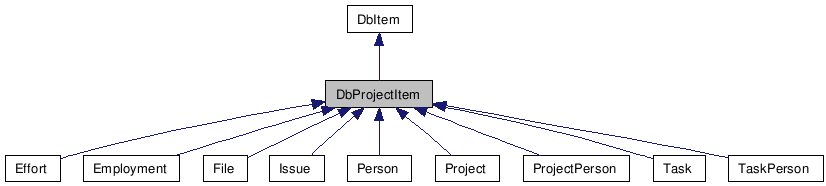
By establishing the right-managing in the item-table we are possible to track all items in a project. Each of those items consists of two parts: ITEM
With ITEM.id and ITEM.type we can get the REST of the items-data by looking into the table of this item-type (likes TASK, PROJECT, PROJECT_PERSON, etc.)
There might be other tables, that use 'Fields' but do not refer to the almighty- item-table those are directly derived from DbItem.
Definition at line 737 of file db_item.inc.php.
 1.5.1-p1